this is our city too
riding a bike for freedom

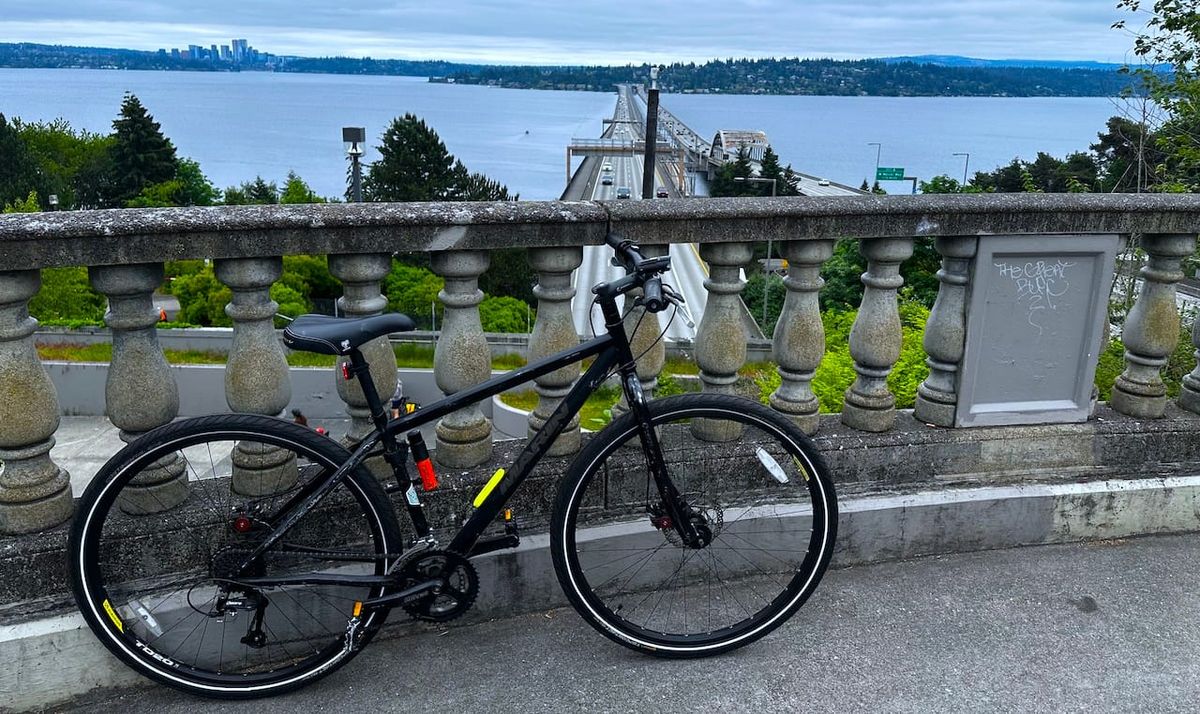
Last Saturday was a thrilling day! Memorial Day weekend marked the first of the summer's Bicycle Weekends. Each weekend until Labor Day, the gorgeous Lake Washington Boulevard closes to cars. Pretty much everything and everyone but cars are free to cruise the 4-mile road along the lake. Resident car access is still allowed; emergency and delivery vehicles can also pass through the barriers. Even the parking lots and boat ramps remain accessible to cars. But the experience is still one that's worth enjoying.
The road's dramatic curves are like the ones in car commercials—in fact, one filmed here last year. And people drive fast here! At least two vehicles have driven into the lake this year. No racetrack, this is a park-lined street with single-family homes that are breathtakingly expensive. In Seattle, we joke about how to calculate the price of houses: if you see water, add a zero to the end. On this stretch of the Mount Baker neighborhood, it's safe to double that number, too.
I rode with about 200 people, including Mayor Katie Wilson, to the north end of the closed road. She rode an e-bike with her daughter on a little bicycle seat trailer hitched to the back. I started out with a crowd from my neighborhood and folks joined us at stops along the way. There were a few speeches and a ribbon cutting. About two dozen rude and rowdy protestors showed up to protest the event. But after all that, the crowd dispersed to bike the boulevard. Adults and children alike rode with little fear of our greatest predator (cars). From one end to the other, people on bikes, wheelchairs, strollers, rollerblades, and even on foot, enjoyed the open road.
finally: a good tradition
This year, Bicycle Weekends covers 15 weekends in the summer, including holidays. The event began as Bicycle Sundays back in 1968. Greg Johnston at the Seattle P.I. interviewed Larry Sunblad from Seattle Parks and Recreation. "The bicyclists at that time came to us saying, 'Why can't there be a time for us to use this area. Look how scenic and flat it is.'" But the intentions for this road actually began around 1903. Then, Seattle City Engineer RH Thomson designed the road to be a cinder path for bicycles. One segment of this road was the first street the City ever paved. And soon enough, the boulevard's users expanded to include carriages and, yes, cars. In the first few months of Covid-19, the city closed the road for the entire summer. By fall, the city began to reopen the street full-time to cars. Bicycle Weekends returned to just a handful of them during the summer.
The protestors held signs expressing their displeasure at losing this road. Some called it an equity issue. Some made sarcastic (I hope) signs that said we were "othering" cars. One asshole held a sign that said "bikes will not replace us," a slogan also seen at that hate rally in Virginia. Mayor Wilson gave the last speech of the morning before we set off for the ride. She addressed the protestors who jeered us riders and all three speakers that day.
"I'm someone who has very often been on the protesting side of things, so I just want to say to you, your experiences matter, your voices matter. I will continue to hear from you. And I just want to acknowledge that when we make decisions like this, about how we're using our right of way and our public space, these are hard decisions, right, because we can't use our space for everything all the time, and so I just want to acknowledge that, and we're going to be monitoring how this works over the course of this year, and we will continue to talk to you, talk with you in the months ahead.”
I'm so used to decisions that feel capricious. Out of my hands. I'm used to struggles where we speak up and protest and fight, only to lose behind closed doors. But here was a decision made with public input for and against. Heard fairly. Not withdrawn at the slightest provocation. Not a decision made in advance of a process.
designing participation around impact alone
I'm still thinking this part through. I've written about the advice process with an abandon that I would describe as joyful. It's a decision-making process that's pretty simple. When we have to solve a problem, the most impacted (people closest to the problem) should get to decide how to solve it. They must first consult with anyone affected by the problem or those who have expertise to share. It's brilliant until you start to use it. The "most impacted" question has lingered on my mind for years. Who is most impacted? What if they make decisions that harm other people? What if their own perspective is murky with bias? I've tried and failed to solve these issues in my implementations.
The advice process fails again on Lake Washington Boulevard. One could argue that the people "closest to the problem" were the ones who lived on this street. In the decision-making workshop I'm attending, the instructors at AORTA addressed this head-on. In their mind, holding power also means holding risk and responsibility. They say, “designing participation around impact alone can produce decisions that feel 'legitimate' but aren't grounded and can actually disempower the people impacted.”
I'm still working on an essay about how I'd restructure the advice process for group decisions. But for now, it is clear that impact alone can't be the only basis for deciding how we make decisions. A city is an ecosystem with long tendrils. The choices we make today will span decades or even centuries.
this is my city too
Seattle is changing as a city. It's growing in ways that so many other cities would welcome. But it doesn't always grow for the benefit of everyone who lives here. This is a problem we can solve as a collective. We can consider people's individual experiences and ground them in the contexts of the larger community.
For too long it has felt like the city has given first preference to the wealthy homeowners in Seattle. The people who fight against new housing proclaim themselves multi-generational Seattleites. But those aren't the only residents in the area. People are going to move here no matter how many homes (or how few) we build. In fact, there are many more of us here than there have ever been. Power and responsibility belong to all of us. We solve the risks together.
Last Saturday afternoon, hundreds of people rode our bikes on a beautiful road we all pay to maintain. I was on a bicycle I love that I've ridden for almost two decades. I cruised down a quiet street that was free of road noise and exhaust. I heard only the murmur of people around me, the laughter of children, and the swaying of trees. I felt the cool wind of the lake blowing against my face. In the city where I've lived for more than a decade, I have rarely felt so free. Why would I keep that feeling all to myself?

 Except where otherwise noted, the essays on this site are licensed under a