reaching for you
relating to the artist and artistry of Medium Build

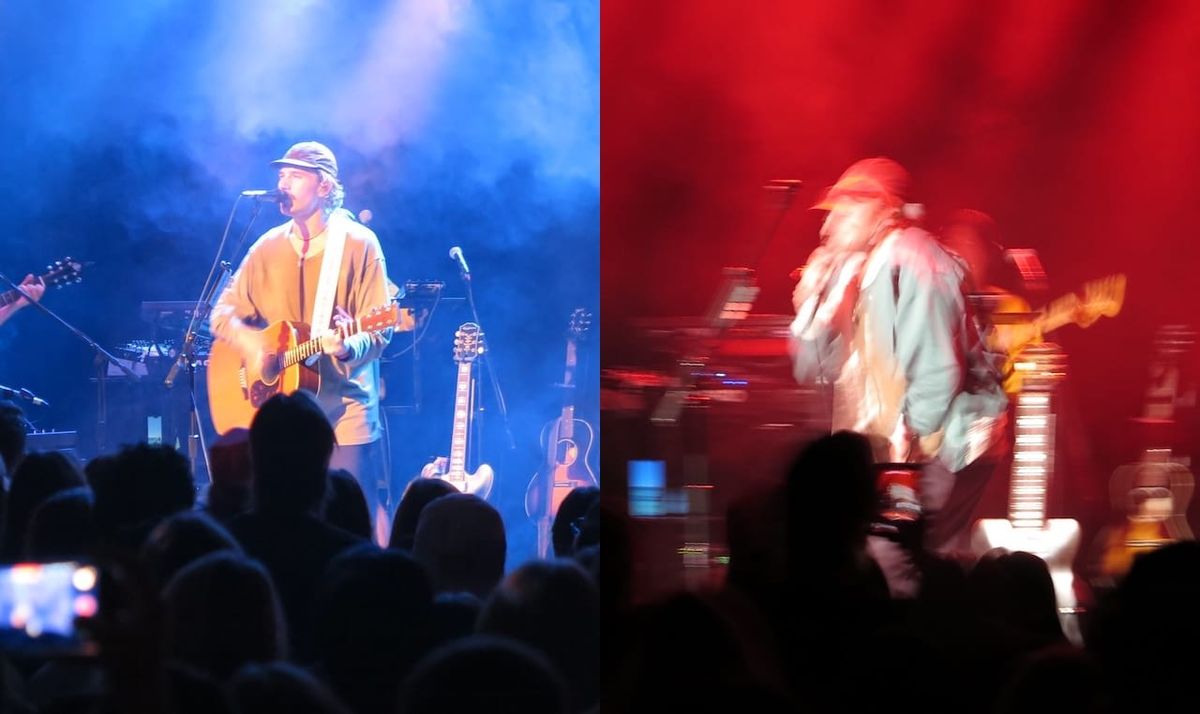
Last week I went to a concert with two of my best friends. We were there to see singer-songwriter Nick Carpenter, who goes by Medium Build on stage. Carpenter has been in the music industry for more than a decade. He comes across as relatable and charming, a person who seems at ease singing deeply personal songs to rooms of 500 or so. Medium Build tells stories about people who have messed up, who loved and lost. He sings about the yearning and mistakes and sparks of growth that dot the lives of most young people. I heard the room sing along to one of his bangers about depression when I thought, "I want to talk to Vincent about this!" Vincent is an internet friend of mine from Toronto. He saw Medium Build a couple weeks ago when the artist toured through Canada. We had a virtual sit-down this week to chat about how we connected to Carpenter's music.
Vincent and I found out by accident that we were both hooked on Medium Build. His music doesn't sound like that of any artist we'd talked about before. Vincent says that his usual flavor of music is well within the "pop diva" realm. He says, "I try to seek out male musicians who use he/him pronouns when referring to a lover," something I do as well. Vincent also likes ballads and slow songs but will on occasion dip into twangier sounds. The twang genre—not quite country, not quite rock—is one of my favorites. I grew up in Austin (the live music capital of the world, thank you). Most of the music from the region, the land of Willie Nelson and Stevie Ray Vaughan, tends to have a little drawl to it. My tastes still include a lot of synthesizers and pop divas, but I have a soft spot for a sad song set to acoustic guitar. Across our conversation, I noticed a few themes in Medium Build's work that resonate with us both.
a different model of masculinity
Carpenter identifies as queer or bisexual. "Everybody's hot!" Carpenter says in one interview. He often leaves the subject of his songs as gender ambiguous, or refers to them as "baby," or the like. On other songs, he make his attraction to many genders more direct. 'Drug dealer' is about the crushes we develop on the service workers in our lives. His drug dealer is a man, his bartender is a woman, and everyone loves "that songwriter" on the same track. He opens 'Thank you, Cook' with the lyrics, “when the masculine in you finds the feminine in me.” Gender is a spectrum in a song about the connections we may have across our long lives. The song is a personal and emotional end to an album full of such moments. But it also touches on personal growth in ways that seem inaccessible to many male musicians. In the first verse he talks about needing Cook more than anything. By the end of the song, he reassures them that the love they once showed him is how he learned to love himself.
His writing also blurs the lines of biography and fiction. Carpenter describes the song 'Hey Sandra,' as a letter that his dad might have written his mom if he needed to win her back. Vincent says, “he's almost mythologizing his dad and and straight male relationships. He wants to win his woman back by writing her a letter. At one point he sings, 'That lil' prick from Texas tried to touch ya and I broke that fucker's hand? [...] You used to like that tough guy act.' It feels like it's part of a story.” It might be this exploration that makes Medium Build's music so compelling. Men can mess up, make mistakes, fail their partners, and apologize. Carpenter’s songs don’t put the blame on the person he’s singing to. It’s not that person’s job to fix him. He can feel torn up about losing them, even long for them, but the work is his to do. Carpenter also sings on several songs about his struggles with body image. Lyrics from older songs like 'FatBrokeLoser' read like painful and self-deprecating diary entries. Newer songs like 'Armor' reveal some growth when he sings, "I wanna starve myself until I'm beautiful. Hey, what the fuck is that? Thought I could fix myself without the dysphoria." This is a topic rarely covered by male musicians, but one that a growing number of men struggle with today. I Medium Build's music offers a model of masculinity that says it’s okay to be vulnerable; it's okay to grow.
storytelling in songwriting
Vincent and I learned that we approach Medium Build's storytelling in different ways. He's not the first artist to sing about messed-up youth and bad breakups. One of my favorite artists, The Mountain Goats aka John Darnielle, often sings in that register. Vincent and I compared Carpenter's lyrics to those of women singer-songwriters like Lana Del Rey and Mitski. Music critics often ask women artists if their songs are autobiographical. This stems from the outdated sexist belief that a woman can only write songs from her own experiences. Sarah MacDonald writes, "Authenticity is mistaken as a synonym for autobiographical, and women have been told by critics, fans and their male colleagues they can only make autobiographical art." Women create personas to blur the lines between reality and fiction in their songs. Darnielle never wrote songs about stories from his own life until The Sunset Tree, his 9th album. Men are free to create personas, too, something Carpenter seems to be urging us to remember.
Carpenter's songwriting focuses on the emotional depths of the characters he sketches. I related to many of the people who show up in these songs. At some points in my life I have been those characters, these former lives of a person who's now grown up. I'm not the only listener who's ever been a little reckless in love. We all feel regret for the things and people we've lost. I am grateful for all the people who have left impressions on the many seasons of my life. 'John and Lydia' is one of a handful of Medium Build's songs that is explicitly about his parents. He intersperses snippets from the past with how he relates to them as an adult. He embraces the freedom of making his own choices and respecting the ones they once made. “Would we have been friends if we were born at the same time?” he sings. “Maybe in another life.”
I asked Vincent how he related to Medium Build's lyrics. I was curious if his life experiences overlapped his songs in the same ways that mine did. It surprised me to learn that, for the most part, he didn't. Instead, Vincent said, “the songs are like watching a movie about someone’s life, one that's not my own.” Songs like ‘Hey Sandra’ and ‘Misery’ are dramatizations of events that happened to someone around him. All artists borrow from and embellish the stories of people they know. But the way Carpenter blurs into his Medium Build persona gives us the thread of truth we need to connect with him.
parasocial connections to a stranger
At the concert, Medium Build sings a line from 'Never Learned to Dance.' It goes, "Buying weed on Wilshire, sexting with my therapist." The crowd sings along with him, but seem to get louder at that part. He grins at us and says something like, "I know you weirdos love that line." Carpenter worries about the fans who think the harmful relationships in his songs are normal. What does this say about us in 2026? A person who sings about depression is once again rising in the music industry? In another recent interview he says, “I get DMs all the time of people being like, "Our song is Triple Marathon." I'm like, "You should check the recipe on that cuz that song is unhealthy.” In many of his songs he wrestles with his growing fame. On ‘Perceived’ he laments having to turn his “private life into entertainment." On ‘Never Learned to Dance’, he sings, “Babe this dream I had feels like it might ruin me.” Despite lyrics that feel too revealing at times, Carpenter still comes across as a private person. Perhaps this is why he's quick to puncture the illusion of his stories in interviews.
I can see the appeal a songwriter might have in blurring the lines on the sources of their inspiration. Singer-songwriters aren't usually manufactured from within the music industry. Authenticity—emerging organically from the grassroots—is part of what they sell. People relate to an artist more if they tell a story that feels real. Songs about trauma feel more real when people who identify with them believe the artist has also experienced it. That vulnerability connects the fan to the artist in very personal ways. But we don't know an artist as a person when we hear their music. Despite the romantic notions we may hold, songwriting and performance is still a job. Artists are still part of a billion-dollar industry. The internet expanded how much access that regular people can have with celebrity. A post-covid decline in face-to-face interactions further fueled this desire for celebrity intimacy. Horton and Wohl first described these interactions as "para-social" in 1956. These are one-sided interactions where the audience falsely thinks they know a celebrity like a friend. It's well-documented that this belief is untrue (but huge business for many industries). It can also make celebrities, especially ones who are new to fame, uncomfortable. In 2024, Chappell Roan famously shared how uneasy parasocial fans made her feel.
do something productive
"I wonder what Nick would think if he read your article," Vincent said near the end of our call. "Would he be like, 'What are these guys talking about?? They don't know me!'" We laughed a little at the idea but I didn't have an answer ready. Writing this essay taught me how little we actually know about the famous people in our lives. I can relate to music without believing that the artist and I are the only survivors of those experiences. We will only know a sliver of most people's lives. Even among our friends, we know the most about what they choose to show us. Vincent is a friend I made from the internet. He visited Seattle once for a work conference but we chat online almost every day. Online interactions can certainly feel parasocial at times. Unlike most celebrity encounters, these potential friends can also deepen into real friendships.
What we do know with intimate familiarity is the interiority of our own lives. It can feel profound when another person holds a key of experience that matches one of the locks in our heart. When we connect with someone, we should see it as an invitation to share more in both directions. Even after we add one or two more colors to our palette, we still can't rely on a picture of the person we paint in our minds.
Medium Build, aka Nick Carpenter, is fascinating for many different reasons. But they're still two different people (or personas). I'm happy that I got to see Medium Build with two friends who are important to me. I'm delighted that Vincent was willing to chat with me on zoom for an hour after work. I'm grateful that Nick Carpenter's art found me when it did. I'm also grateful that he helped me create a deeper connection with some of the real friends in my life.
Thanks so much to my pal Vincent for talking with me this week!
 Except where otherwise noted, the essays on this site are licensed under a